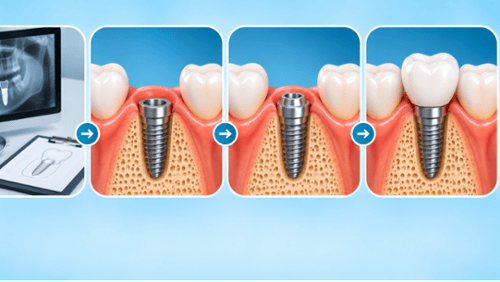
Restoring your smile with dental implants is a multi-step journey designed to ensure stability, function and natural aesthetics. Knowing what to expect at each stage helps relieve uncertainty and lets you plan. The complete process generally spans three to nine months, depending on individual healing rates, bone density and whether preliminary treatments are needed. Understanding the step-by-step timeline gives you a clearer view of what lies ahead as you work toward a fully restored smile.
How Long Do Dental Implants Take From Start to Finish?
It helps to break the process into distinct phases. The implant timeline is not a single appointment but a structured biological journey in which your jawbone gradually integrates with the implant post. The overall timeline usually fits these general frames:
- Standard cases without bone grafting: 3 to 6 months
- Cases requiring bone grafting or sinus lifts: 6 to 9 months or longer
- Same-day implant procedures: A temporary tooth is placed right away, followed by 3 to 6 months of healing before the final restoration
Every mouth heals at its own pace, so your personal timeline depends on how quickly your bone integrates with the titanium post and how smoothly your tissue recovers.
Step 1: Initial Consultation and Digital Treatment Planning
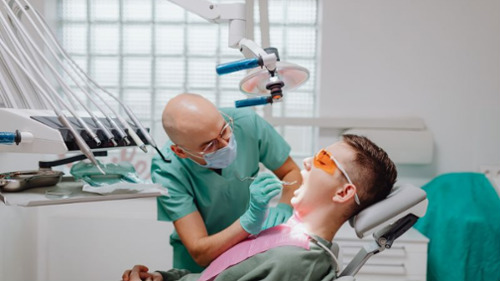
Every successful implant journey begins with a thorough exam and digital treatment planning. Your dental provider evaluates your oral health, reviews your medical history and takes high-resolution 3D cone beam scans.
These scans let your clinician assess jawbone quality, map nerve positions and determine the exact angle for implant placement. Our office also offers Yomi robotic dental implants for added precision during placement. If any underlying issues exist, such as active gum disease or decay in adjacent teeth, they must be treated first. Once your provider confirms you are a suitable candidate, a customized plan outlines each step of your care.
Step 2: Preparing the Jawbone With Bone Grafting or Extractions
If a damaged tooth is still present, an extraction is performed before or alongside implant placement. If the jawbone lacks the height or density to support a post, a bone graft or sinus lift may be needed. You can read more about how bone loss affects implant candidacy.
Bone grafting introduces natural or synthetic graft material to reinforce the target area. When a graft is placed, a healing period of three to six months is typically needed for new bone to form and solidify. This step adds time, but a sturdy foundation is essential for long-term implant success.
Step 3: Surgical Placement of the Dental Implant Post
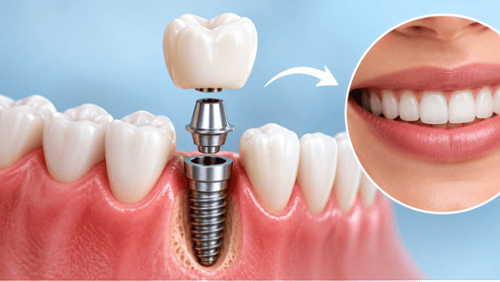
Once the jawbone is strong and fully prepared, the next stage is placing the implant post. Under local anesthesia or comfortable sedation, a small incision is made in the gum line to expose the bone. A precise pilot hole is created and the biocompatible titanium post is positioned securely in the jaw.
A protective healing cap or cover screw is then placed over the implant, and the gum tissue is gently closed around or over it. Many patients worry about discomfort at this stage, and our FAQ on whether dental implant surgery is painful covers what to expect. Most patients need minimal downtime and return to light activities fairly quickly, though your dentist will advise you based on your case.
Step 4: The Osseointegration Period and Soft Tissue Healing
The core stage of the implant process is osseointegration. This is when your natural bone cells attach directly to the surface of the titanium post, anchoring it securely in the jaw.
Osseointegration typically takes three to six months. During this period you will wear a temporary tooth or bridge to maintain your appearance and function without putting heavy biting forces on the healing post. You will also attend brief follow-up visits so your clinical team can monitor bone integration and gum healing.
Step 5: Abutment Attachment and Final Crown Impression
After osseointegration is verified, a minor procedure attaches the abutment. This small connector piece sits at the gumline and anchors your custom permanent restoration.
In some cases, the gum tissue is given a short time to heal around the abutment. Once the surrounding tissue has formed a healthy seal, your provider takes digital or physical impressions of your teeth. These measurements go to a dental laboratory, where technicians craft your custom crown, bridge or denture to match the shape, shade and alignment of your natural teeth.
Step 6: Final Restoration Placement and Long-Term Maintenance
The final step is placing your permanent crown or prosthetic. Your provider checks the fit, bite alignment and color match to ensure it blends with your adjacent natural teeth. Once everything feels comfortable, the final restoration is permanently attached or screwed into place.
Maintaining it involves daily brushing, flossing and regular professional checkups. Our guide to keeping your dental implants healthy walks you through the routine. With good hygiene habits, implants offer a long-lasting solution designed to support comfortable eating, clear speech and a confident smile for years to come.
Key Factors That Influence Your Dental Implant Timeline
No two treatment plans are identical. Several individual factors affect the speed of healing and restoration:
- Bone density and structure: Strong natural bone allows faster placement and stabilization, while compromised bone needs extra graft healing time.
- Number of teeth replaced: Single-tooth replacements often move faster than full-arch restorations or complex full-mouth reconstructions.
- Gum and overall health: Conditions like uncontrolled diabetes or active gum inflammation can slow tissue recovery and bone integration.
- Lifestyle choices: Tobacco use can interfere with blood supply to healing tissue, potentially extending osseointegration or raising surgical risks.
- Following aftercare: Following post-operative guidelines, keeping to soft foods when instructed and attending scheduled follow-ups keep your timeline on track.
How Long Do Dental Implants Take Compared to Other Tooth Replacement Options?
Here is how timelines and features compare across common restorative choices.
Dental implants
- Total timeline: 3 to 9 months
- Primary advantage: Anchors directly in bone, helping to preserve natural jawbone structure over time.
- Main considerations: Requires a multi-stage healing process and an osseointegration period.
Traditional dental bridges
- Total timeline: Often a few weeks, and in some cases a single visit with same-day crowns and bridges
- Primary advantage: Faster turnaround with no bone grafting or surgical healing needed.
- Main considerations: Requires removing outer enamel from adjacent healthy teeth to anchor the bridge.
Removable partial dentures
- Total timeline: Typically a few weeks
- Primary advantage: Non-invasive, with a lower initial investment.
- Main considerations: Requires periodic adjustments over time and daily removal for cleaning.
Although implants need a longer upfront commitment, their ability to support jawbone health and function like natural teeth makes them a popular long-term choice. If you currently wear dentures, see how you can get dental implants while wearing dentures. And if you are not sure what happens when a tooth is left alone, read what happens when a missing tooth is left untreated.
Schedule Your Consultation at WinningSmiles Custom Dentistry & Implant Center in Fontana, CA
If you are ready to explore your tooth replacement options and want a personalized breakdown of your timeline, our team is here to guide you. Contact WinningSmiles Custom Dentistry & Implant Center today to book your comprehensive consultation and take the first step toward a restored, functional smile. You can also review our financing options before your visit.
Frequently Asked Questions About the Dental Implant Timeline
How long do dental implants take if I do not need a bone graft?
If your jawbone is healthy and dense enough to support an implant without grafting, the standard timeline is typically around three to six months from placement to final crown attachment.
How long do dental implants take to heal after placement surgery?
Initial gum healing generally takes a week or two. The complete process of osseointegration, where the bone fuses to the post, takes three to six months.
Can I get a temporary tooth while waiting for my final restoration?
Yes. Temporary crowns, flippers or removable bridges are commonly provided, so you do not have to go without a tooth while your implant heals beneath the surface.
Why does osseointegration take several months to complete?
Osseointegration depends on natural biological cell growth. Your body needs time to build living bone tissue directly around the microscopic surface of the titanium post to ensure firm stability.
What happens if my implant healing takes longer than expected?
Healing speed varies between individuals. If bone integration is slower than average, your clinician extends the healing period slightly before placing the final crown to protect your long-term success.