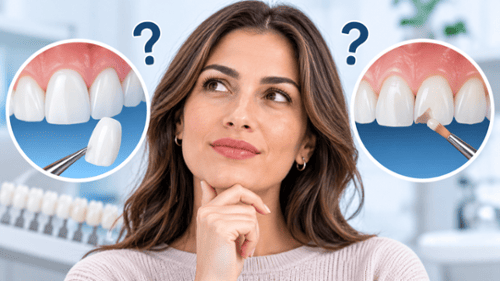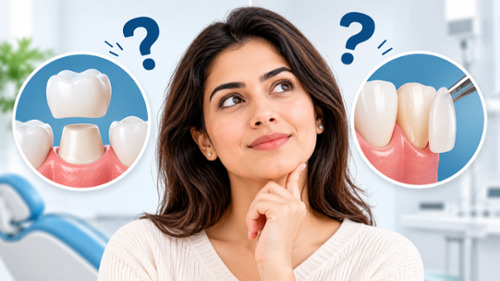
A crown covers the whole tooth. A veneer covers only the front. If a tooth is cracked, heavily filled, or has had a root canal, a crown is usually the right choice. If the tooth is structurally sound and the concern is its color, shape, chips, or small gaps, a veneer is often enough. Which one you need depends on how much healthy tooth you have and what you want to fix.
Here is how the two compare, when each makes sense, and how we decide.
What is the difference between a crown and a veneer?
The American Dental Association describes a crown as a cap that covers a tooth to restore its normal shape and size, and that can strengthen the tooth and improve its appearance. To place one, the dentist shapes the whole tooth down so the crown can fit over it on every side.
A veneer is a thin shell, usually porcelain, bonded to the front surface of a tooth. Only a small amount of the front of the tooth is prepared, so more of the natural tooth is kept. A veneer changes how a tooth looks. A crown does that and also protects a tooth that has lost strength.
| Crown | Veneer | |
|---|---|---|
| Coverage | The whole tooth, all sides | The front surface of the tooth |
| Main purpose | Protect and restore a weak or damaged tooth | Improve color, shape, and appearance |
| Tooth preparation | More of the tooth is shaped down | Less of the tooth is changed |
| Best for | Cracked, broken, heavily filled, or root canal treated teeth | Healthy teeth that are stained, chipped, worn, or uneven |
| Strength | Adds strength to a weakened tooth | Improves appearance, does not rebuild a weak tooth |
When a crown is the better choice
A crown makes sense when the tooth needs protection and not only a better look.
- A large filling or a lot of decay. When much of the tooth is gone, the remaining structure needs support.
- A cracked or broken tooth. A crown holds the pieces together and spreads chewing force.
- After a root canal. Back teeth in particular usually need a crown, because a tooth without its nerve can become more brittle. Our article on how a root canal differs for a front tooth and a molar explains when a crown is needed.
- A weak tooth that takes heavy chewing. Molars and premolars carry a lot of force.
- To anchor a bridge or cover an implant.
Crowns can also fix a tooth with a badly worn or misshapen surface. If you are not sure why a crown was recommended, our post on the common reasons for a dental crown goes through the options.
When a veneer is the better choice
A veneer works well when the tooth itself is healthy and the concern is cosmetic.
- Stains that do not respond to whitening. Some discoloration lives deep in the tooth and does not lift with whitening.
- Chipped or slightly worn front teeth.
- Small gaps between teeth.
- Teeth that are uneven, short, or oddly shaped.
- Minor crowding that you do not want to treat with braces or aligners.
Veneers are most often used on the front teeth you show when you smile. We have photographed many of these cases in our gallery, including a set of crowns and veneers used together to build a natural looking smile.
Can veneers and crowns be used together?
Yes, and it is common. A smile makeover often mixes the two. A veneer might be used on a healthy front tooth while a crown protects a neighboring tooth that had a root canal or a large filling. The goal is a set of teeth that match in color and shape, whatever is underneath.
How about bonding?
Dental bonding uses tooth colored material shaped directly onto the tooth, and it is a more conservative option for small chips and gaps. Our post on porcelain veneers vs dental bonding compares those two, and is a good next read if your concern is a chip or a gap.
How we decide which option is right for you
- We examine the tooth and take an X-ray. We look at how much healthy structure remains, the condition of the nerve and gums, and how you bite.
- We talk about what you want. Some people want a smile makeover. Others only want a cracked tooth protected.
- We explain the options. That may include bonding, a veneer, a crown, or a combination, with the reasons behind each.
- We plan the shade and shape. For visible teeth, color and shape are matched to your other teeth and your face.
You can read more about our approach on our cosmetic and general dentistry page.
Caring for crowns and veneers
Both restorations last longest with the same basics. Brush twice a day, floss daily, and keep your regular cleanings so we can check the edges where the restoration meets the tooth. Avoid using your teeth to open packages or bite hard objects, and let us know if you grind your teeth at night, because a night guard protects both crowns and veneers from heavy pressure. A restoration still sits on a natural tooth, and that tooth can still get a cavity at the edge, so good home care matters just as much after treatment as before it.
Frequently asked questions
Is a crown stronger than a veneer?
For a weakened tooth, yes. A crown covers and supports the whole tooth. A veneer improves appearance and is best on healthy teeth that do not need structural support.
Which removes more of the natural tooth?
A crown, because the whole tooth is shaped to fit under it. A veneer changes less of the tooth, mainly the front surface.
Can I get a veneer on a tooth that had a root canal?
Sometimes, but a crown is more often recommended on a root canal treated tooth, especially in the back. We look at how much tooth structure remains before choosing.
Can a crown be made to look natural?
Yes. Crowns can be made in porcelain or ceramic and matched to the shade and shape of your other teeth. Our same day crowns and bridges let you see this process in our office.
Do I need a crown or a veneer for a chipped front tooth?
It depends on the size of the chip. A small chip may only need bonding. A larger chip may call for a veneer. A chip that exposes the inside of the tooth, or one that cracks the tooth, may need a crown. An exam tells us which.
Find out which option fits your tooth
The right choice depends on your tooth, not on a rule of thumb. To talk through your options, call WinningSmiles in Fontana at (909) 822-3003 or contact us online.