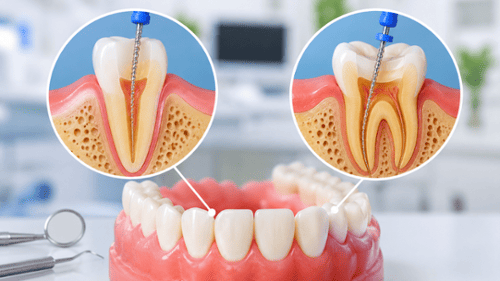
A root canal on a front tooth and a root canal on a molar remove the same thing: pulp that has become infected or inflamed. The work looks very different from one tooth to the next, though. A front tooth usually has one canal and is the quicker, simpler treatment. A molar has several canals, takes longer to clean, and almost always needs a crown afterward. A front tooth brings its own question, which is how it will look when treatment is done.
If you have been told you need a root canal on a tooth you can see when you smile, or on one at the back that you use for every meal, here is what changes and what stays the same.
Front tooth vs molar: the differences at a glance
| Tooth type | Typical roots and canals | How the tooth is reached | Usual restoration |
|---|---|---|---|
| Front teeth (incisors and canines) | One root, usually one canal | Small opening on the back, tongue side of the tooth | Filling or crown, depending on how much natural tooth remains |
| Premolars | One or two roots, often one or two canals | Opening in the chewing surface | Crown in most cases |
| Molars | Two or three roots, often three or four canals | Larger opening in the chewing surface | Crown in almost every case |
Every mouth is a little different, so these are typical patterns, not rules. An X-ray and an exam tell us what your tooth actually looks like on the inside.
How many canals does each tooth have?
The canals are the narrow channels inside each root that hold the tooth's nerve and blood supply. When that tissue becomes infected, the root canal procedure removes it, cleans the canals, and seals them.
Front teeth are the simplest. They usually have a single root with a single canal, and that canal tends to be fairly straight. Premolars sit in the middle. Some have one canal and some have two. Molars are the most complex. Lower molars commonly have two roots, and upper molars commonly have three, with three or four canals between them. Some of those canals are thin and curved, and finding and cleaning every one takes time and care.
This is the main reason a molar root canal takes longer than a front tooth root canal. More canals means more cleaning, more shaping, and more sealing.
What a front tooth root canal involves
Front teeth are what people see when you talk and smile, so the goals are a little different. We want to clear the infection and keep the tooth looking natural.
Reaching the nerve from the back of the tooth
On a front tooth, the small access opening is made on the tongue side, not the side that shows. That keeps the front surface of the tooth intact. The tooth is numbed first, the infected or inflamed tissue is removed, and the canal is cleaned, flushed, and filled with an inert material. We use rotary endodontic instruments, which are more comfortable than the manual files used in the past.
Patients who feel anxious about dental work can ask us about sedation dentistry before the appointment. Having a calm visit matters just as much for a single front tooth as for a molar.
Will a front tooth change color?
Sometimes. A tooth that has had a root canal can darken gradually over time, and this is more noticeable on a front tooth. A tooth that was already discolored from trauma or infection before treatment may stay that way.
There are good options if it happens. Internal bleaching lightens the tooth from the inside, and we have photographed results in our gallery, including a case of internal bleaching after root canal treatment. If the tooth is heavily damaged or the color change is significant, a crown can restore both strength and shade. If you are worried about how a front tooth will look, say so at your consultation. It changes how we plan the restoration.
Why a molar root canal takes longer
Back teeth do most of the heavy chewing, and they carry the most complicated anatomy. With a molar, the dentist has to locate every canal, including narrow ones that curve, then clean and seal each one thoroughly. A missed canal can leave bacteria behind, which is why this part cannot be rushed.
Molars also sit deep in the mouth, so visibility and access are harder. Isolating the tooth from saliva takes more care, and appointments tend to be longer. None of that changes the goal. The aim is the same as with a front tooth: remove the infection and save the natural tooth.
If you have been putting off treatment because of what you heard about root canals, our article on saving your natural tooth with root canal therapy covers why keeping the tooth usually beats the alternatives.
Do you need a crown after a root canal?
This is where front teeth and molars separate most clearly.
After a root canal, a tooth has lost its nerve and often a good part of its structure, either from the original decay or from the access opening. The American Association of Endodontists notes that after treatment the tooth is restored with a crown or a filling for protection. Which one you get depends on the tooth.
Molars and premolars: A crown is the standard recommendation. These teeth absorb strong chewing forces every day, and a treated tooth without full coverage is more likely to fracture. A crown spreads that force and protects what is left.
Front teeth: Chewing forces are lighter, so a front tooth with plenty of healthy structure left may be restored with a filling in the access opening. If the tooth is heavily broken down, has a large old filling, or is discolored, a crown is often the better choice for strength and appearance.
We place the final restoration at a later visit once the tooth is ready, and a temporary closure protects the tooth in between. Please do not skip that last step. Our same day crowns and bridges service means the permanent restoration can often be made quickly in our office, so the tooth does not stay unprotected for long.
Recovery after a front tooth vs a molar root canal
The numbness wears off within a few hours. Many patients then notice mild soreness around the tooth for a few days, which usually responds to over the counter pain relievers taken as directed. Some tenderness when biting is normal early on, because the tissue around the root has been irritated by the infection and the treatment.
A few differences are worth knowing:
- Front teeth: Recovery tends to be quick, and the main thing to watch is how the tooth looks over the following months.
- Molars: Soreness can last a little longer, partly because the appointment is longer and the jaw may be tired from holding open.
- Both: Avoid biting hard foods on the treated tooth until the permanent restoration is in place.
Pain that gets worse after the first few days, swelling, or a bad taste should not wait. Call us so we can take a look.
What if a root canal tooth hurts again?
Sometimes a tooth that has had a root canal becomes painful months or years later. A hidden canal, a crack, or a crown that no longer seals well can allow bacteria back in. In many cases the tooth can be retreated. The old filling material is removed, the canals are cleaned again, and the tooth is resealed.
Retreatment is often worth trying, especially on a front tooth where losing the tooth would be very visible. The American Association of Endodontists states that with proper care, most teeth that have had root canal treatment can last a lifetime. Good home care, regular checkups, and a well fitted final restoration all help your treated tooth get there.
The procedure step by step
The steps are the same for every tooth. What changes is how long each one takes and how many canals are involved.
- Exam and X-ray. We look at the tooth, test how it responds, and take an X-ray to see the roots, the surrounding bone, and any sign of infection.
- Numbing. The tooth and the tissue around it are numbed so you do not feel pain during treatment.
- Isolating the tooth. A thin protective sheet keeps the tooth dry and clean while we work inside it.
- Opening the tooth. A small access opening gives us a path to the pulp chamber. On a front tooth this is behind the tooth. On a molar it is through the top.
- Cleaning and shaping. The infected tissue is removed, and each canal is cleaned and shaped so it can be filled.
- Filling and sealing. The cleaned canals are filled with an inert material, and the opening is closed with a temporary filling.
- Final restoration. At a later visit, the tooth gets its permanent filling or crown.
With a front tooth, steps four through six are often shorter because there is typically one canal to work on. With a molar, the same steps repeat for each canal, and finding all of them is a skill in its own right.
Root canal or extraction on a front tooth or molar?
When a tooth is badly infected, the choice is usually between saving it with a root canal or removing it. Saving the natural tooth is generally preferred when it can be restored, because your own tooth keeps working with your bite and supports the bone around it.
That reasoning applies to both ends of the mouth, but it feels different. Losing a front tooth is obvious the moment you smile, and replacing it takes planning. Losing a molar may not be visible, but the teeth around it can drift into the gap, and chewing gets harder on that side. Some teeth are too damaged to save, such as those with a deep vertical crack or too little structure left to hold a restoration. If that happens, an implant or bridge may be the next step, and we can walk you through those options at your visit. Our article on what happens when a missing tooth is left untreated explains why leaving a gap is rarely a good idea.
Caring for a tooth after a root canal
A root canal treated tooth still needs the same care as any other tooth, and arguably a little more.
- Brush twice a day and floss daily, including around the crown or filling.
- Do not chew ice, hard candy, or pens with a treated tooth, especially a molar before its crown is placed.
- Keep your regular checkups and cleanings. We check the margin of the restoration and the bone around the root on X-rays.
- Tell us if the tooth starts to feel different, even if the change seems minor.
Cavities can still form on a treated tooth, because the tooth's outer structure is still vulnerable to decay. A tooth without a nerve cannot warn you with pain, which makes regular exams more valuable.
Questions worth asking at your consultation
Before treatment, it helps to ask a few things so you know what to expect for your specific tooth.
- How many canals does my tooth have, based on my X-ray?
- Will I need a crown, or can the tooth be restored with a filling?
- If it is a front tooth, how will you handle the color and shape?
- How soon will the final restoration be placed?
- What should I do if I have pain or swelling between visits?
Good answers to these questions should leave you with a clear plan from the first appointment to the last one.
Signs a front tooth or molar may need a root canal
The warning signs are similar whichever tooth is involved:
- A toothache that lingers or wakes you at night
- Sensitivity to hot or cold that stays after the drink is gone
- Pain when you bite or press on the tooth
- Swelling or tenderness in the gum near the tooth
- A pimple like bump on the gum
- A tooth that has turned gray or darker than its neighbors
Not every tooth with these signs needs a root canal, and some infected teeth cause no pain at all. That is why an exam and X-ray matter. If you have severe pain or swelling, our same day emergency care can get you seen quickly.
Frequently asked questions
Does a root canal on a front tooth hurt more than on a molar?
No. Both are done under local anesthetic, so you should not feel sharp pain during the procedure. Pressure and vibration are normal. Afterward, soreness is usually mild for both. Molars can be a little more tiring because the visit runs longer.
How long does a front tooth root canal take compared with a molar?
A front tooth usually takes less time because it typically has a single canal. A molar has more canals to find, clean, and seal, so the visit is longer. We will give you a realistic idea once we have seen your X-ray.
Will my front tooth turn dark after a root canal?
It can darken over time, though not every tooth does. Internal bleaching, a veneer, or a crown can restore the color. Tell us at your consultation if appearance is a concern so we can plan for it.
Is a crown always needed on a front tooth?
No. If enough healthy tooth structure remains, a front tooth can sometimes be restored with a filling. Molars almost always need a crown. Your dentist will recommend what protects the tooth best after reviewing it.
Can a tooth that had a root canal be treated again?
Often, yes. Retreatment cleans the canals again and reseals the tooth. It is usually worth considering before extraction, especially for a front tooth.
Get your tooth looked at in Fontana
Whether the tooth is at the front or the back, an infected tooth does not heal on its own, and waiting usually makes treatment harder. Our root canal therapy page explains how we treat teeth in our Fontana office. To book an exam or get help with tooth pain, call WinningSmiles at (909) 550-5243 or send us a message.

